Do you grow teary while listening to beautiful music?
Are you furious when you spot injustices?
Do you ruminate about unkind comments made by strangers on the internet?
Are you distracted by chewing, the quiet buzzing of a device plugged into a charging port, or by fluorescent lights?
Do you feel an all-consuming drive to create, followed by periods of complete and total depletion?
When you are joyful, do you become so loud, animated, or intense that it startles others?
Have you been called a know-it-all, too much, an overthinker, or too smart for your own good?
Do you wonder about the meaning of life and what we’re all doing here?
Do you seek out interesting and stimulating experiences, only to find yourself needing to hide in a dark closet for a week?
If these resonate, you may be highly sensitive, gifted, creative, neurodivergent, or any combination of these. Today’s article is for you.
Deeply Feeling, Deeply Perceiving
For better or worse, I have come to accept that I am one of these deeply feeling, sensitive individuals. I am attuned to, aware of, bothered by, and delighted by the little things in life. I perceive things others may not, have a harder time shaking them off, and will spend a lifetime modifying my environment to support my nervous system.
Yet this sensitivity is also one of my greatest strengths, allowing me to find endless beauty and gratitude in everyday occurrences. It allows me to tap a deep well of emotion to fuel my writing. It makes me a sensitive and responsive parent. And it provides the empathic insight that many of my gifted clients require.
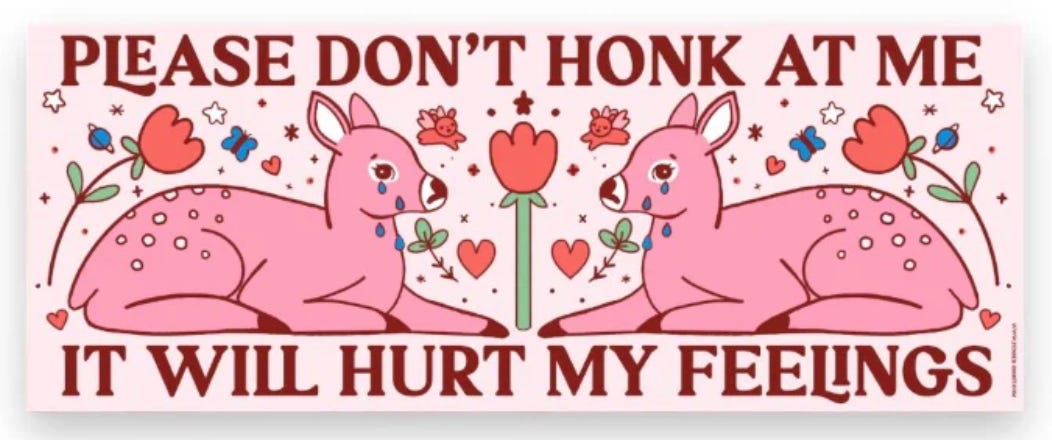
The hymn of the highly sensitive, in bumper sticker form.
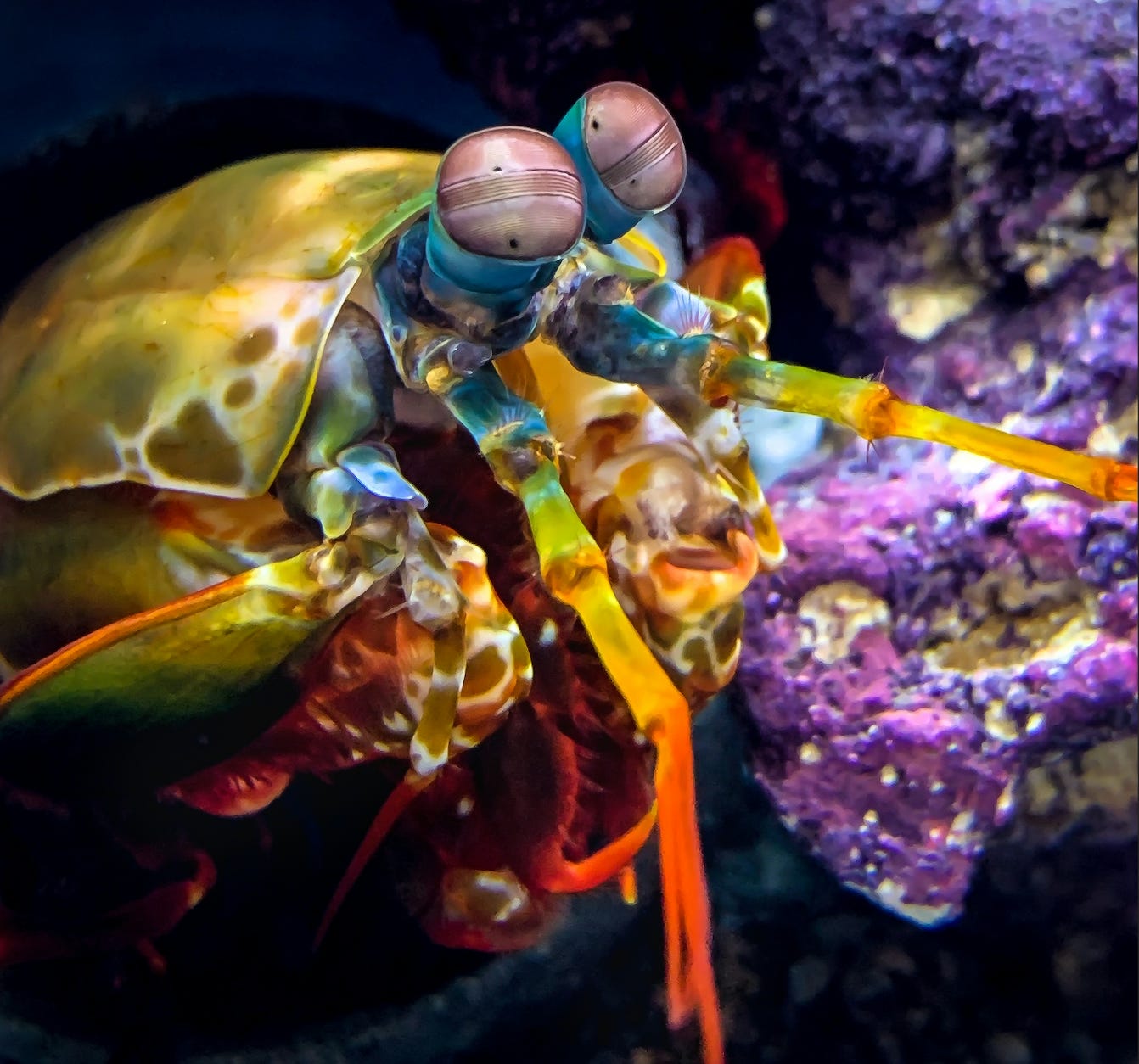
Yet to be gifted and sensitive is a lot like the paradox of the mantis shrimp.1 Most creatures have three or four photoreceptors, allowing them to detect the world in red, blue, and green. Mathematically, there is very little reason why a creature needs more than this to see in our world; four photoreceptors allow you to perceive every color of the rainbow, including ultraviolet light. Yet the mantis shrimp has a whopping 12 photoreceptors.
You’d think this would be of great benefit to the mantis shrimp; if four photoreceptors are great, 12 must be fantastic! But the mantis shrimp actually has terrible color discrimination. One imagines that seeing all those colors is disorienting, overwhelming, and confusing.
Being gifted and highly sensitive is much like this: there are wonderful qualities to it, such as seeing beauty in the details that few others notice. But you may also have a harder time with some everyday things that others take for granted, like tuning out environmental noise, meeting others who understand you, or going out into the world without becoming overwhelmed.
As my dear friend and gifted coach, Erin Krellwitz, says:
“What is easy for the gifted is often hard for others. What is hard for the gifted is often easy for others.”
If this sounds like your experience, you may have found yourself seeking solutions for your sensitivity. Perhaps you still are. Wouldn’t it be lovely if you could experience the profound beauty of the world without experiencing everything so intensely?
Unfortunately, this is a bit of a monkey's paw situation; we cannot remove ourselves from all our sensitivity and intensity without also destroying something essential in ourselves.
The hyper-perceptive mantis shrimp. Photo Credit: William Warby on Unsplash
Sensitive folks who use drugs or other substances to dial back the intensity of their experiences may have noticed this problem: blunting bad experiences might be nice for a while, but it often has the adverse effect of blunting our good experiences as well. While we may feel less pain, we also experience less joy, and the world quickly becomes homogenous and flat.
Fortunately, there are ways to retain your exquisite sensitivity without melting down emotionally, denying your ambition, living in a constant state of overwhelm, or spending your time alone in a cave.
What follows are a few helpful suggestions I have found effective for my gifted, sensitive clients.
1. Learn About Your Needs
When we don’t understand our true nature, many of us come to believe that our differences are the problem. This is doubly true if you’ve never really met others like you or don’t know that others share similar experiences.
There is debate about the extent to which personality constructs such as sensitivity, openness to new experience, curiosity, and intensity overlap with the concept of giftedness. However, in practice, these often co-occur, and the delineation isn’t particularly necessary. Learning about these constructs generally can help you recognize yourself and see that they are simply different ways of being in the world, not pathologies.
Sensitivity
The concept of high sensitivity, or sensory processing sensitivity (SPS), was developed in the 1990’s by psychologist Elaine Aron, who has since written several helpful books on the subject, like this one.
Reading about SPS (like this article) can help you better understand yourself, predict your needs, and modify your environment. You can also take the free Highly Sensitive Person Scale (HSP-R) to understand where you score on this trait.
SPS is not specific to gifted populations (about 30% of the total population has SPS, while 2%-10% are gifted depending on the definition), but SPS does come up frequently in the gifted lived-experience discourse, suggesting it may be more common among the gifted (though we have no specific studies yet to say either way).
Intensity
Dabrowski’s Theory of Positive Disintegration (TPD) is another theory that is not gifted-specific, but it is an enormously helpful framework for understanding intensity, which is common in gifted and neurodivergent folks broadly.
As part of his theory, Dabrowski viewed intense reactions and experiences, which he called overexcitabilities (OE’s),as catalysts for personality development. He identified five domains in which these occur: emotional, psychomotor, intellectual, sensual, and imaginational. Importantly, while these can be indicative of mental health conditions like anxiety, ADHD, or psychosis, Dabrowski believed that when harnessed and supported, intensity can become fuel for advanced moral development.
The presence of OE’s doesn’t rule out the possibility of a mental health condition, disability, or other cognitive difference, so it’s important to work with a trained provider to understand your needs. However, the TPD is a neuro-affirming framework that may speak to you. There are many resources out there, but this is my favorite book on the subject.
Giftedness
Another helpful thing to do is learn about giftedness itself. Different scholars and theorists view giftedness differently, depending on whether their orientation is psychological, biological, talent or education-focused, and so on. Just as there is no one way to be gifted, there is also no unified definition that applies across all fields of study. Yet learning about the general attributes, needs, proclivities, and expressions of giftedness can be very affirming.
Subscribing to the Beyond Gifted Substack will give you an abundance of information on giftedness (and paid subscribers get immediate access to the entire library of evidence-based articles).
2. Find Other People Who Understand
We often feel like we are the only people in the world who feel as we do. This can trick us into thinking we are weird, which further isolates us. When you’re gifted and sensitive, it’s important to understand that you’re not a weird horse—you’re a normal zebra.
Unfortunately, most providers are used to working with horses, so when you tell them you’re a zebra, they often won’t understand right away. They may also not have had any training in working with gifted people like you.
Because of the zebra effect, I have seen over many years that sensitive, gifted people heal best in peer communities with others like them. Many such communities exist online; I lead gifted community groups via Zoom. There are also conferences, seminars, gatherings, and workshops for gifted, 2e, and sensitive folks where you can find peers.
You’re one of the zebras—not a weird horse. Photo by Sutirta Budiman on Unsplash.
Finally, it is worth your time to find a therapist, coach, or other provider who understands giftedness first-hand. There is nothing worse than going to someone for support, only to find they just really don’t understand how your brain functions, and leaving a session feeling even worse about yourself.
Finding qualified providers can be challenging, but I developed The Gifted Provider Directory to help with your search.
3. Grow Your Toolkit
When we’re intensely sensitive, it can feel like we were born under-equipped to handle the intense emotions that can consume us. Fortunately, there are evidence-based ways to increase our ability to handle stress, negative emotions, and emotional overwhelm.
Dialectical behavioral therapy (DBT) is one such technique. Originally created by psychologist Marsha Linehan to treat individuals like herself who struggled with chronic suicidality and borderline personality disorder, it is also enormously helpful for those who are prone to general emotional dysregulation and deep feelings that can overpower cognitive resources.
The four core practices of DBT focus on mindfulness, distress tolerance, emotion regulation, and interpersonal effectiveness. Yet these go far beyond the typical advice to just “meditate and breathe,” which can be inadequate for deeply feeling people.
Examples of DBT strategies include in-the-moment responses such as splashing cold water on your face when you’re emotionally overwhelmed, distracting yourself with intense physical activity, or using mildly painful fidget objects. Long-term, DBT and other evidence-based therapies, like Acceptance and Commitment Therapy (ACT), can help you develop lasting skills like mindfulness, which can rewire your brain for greater calm and safety.
Journaling can be an effective way to cope with overwhelming feelings. Photo by Fa Barboza on Unsplash.
There are a number of fantastic therapeutic workbooks out there, like this one, that you can use to self-reflect. I also recommend finding a licensed provider trained in giftedness, DBT, ACT, cognitive behavioral therapy (CBT), or other evidence-based treatments if you need more support.
Note: 988 is the hotline to call in the United States if you are suffering a psychiatric emergency or need someone to talk with immediately.
4. Tell Your Story
Sometimes the best way to manage is to talk about your experience. I’m actively soliciting work from gifted, sensitive, and creative individuals who would like their stories featured here or for a book I’m currently writing.
Sensitivity, intensity, and giftedness can be beautiful, life-giving qualities when harnessed and supported. They can also cause a lot of trouble if we don’t honor and understand them. Taking some time to research your needs, find others who understand and can support you, and develop skills to effectively manage your sensitivity goes a long way toward greater peace and self-acceptance.
🧠 This article took a lifetime of lived experience, a graduate degree in gifted education, 15+ years working with gifted folks, and 7 hours of research, writing, and editing to create.
I specialize in supporting bright, intense, and creative minds from infancy through adulthood. Whether you are seeking school placement for a gifted child, navigating career choices as an adult, or exploring your gifted identity, I offer personalized, compassionate support.
Interested in joining an upcoming gifted group? 👉🏻 Register here.
For education, parenting, or career support 👉🏻here
Thank you, Emmaly, for this incredibly insightful and helpful article. It is helping me to reframe the intensity of my current deep sensitivity and grief related to ecological and human rights issues. I have archived it to delve more and deeper soon and hopefully put more tools to good use. Friends' and loved ones' perpetual advice to "rebalance" my life really not helpful in the moment. My true gifted friends are not as available at the moment- likely sharing a similar emotional overwhem.







Thank you, Emmaly, for this incredibly insightful and helpful article. It is helping me to reframe the intensity of my current deep sensitivity and grief related to ecological and human rights issues. I have archived it to delve more and deeper soon and hopefully put more tools to good use. Friends' and loved ones' perpetual advice to "rebalance" my life really not helpful in the moment. My true gifted friends are not as available at the moment- likely sharing a similar emotional overwhem.
One of my big triggers is when other people are eating cereal and smacking their lips! Full blown body discomfort. 😭